Rai Way and EI Towers: Eleven Years, Two Attempts, No Deal
Why Italy's broadcast tower champion has never been born, and what the balance sheets say about the reason
1. Introduction
Rai Way and EI Towers own and operate almost all of the infrastructure that broadcasts television and radio signals across Italy. Between them they control roughly 4,700 sites, and putting the two networks under one roof has been an obvious industrial idea for over a decade. It has also failed, or been blocked, three separate times: in 2015, when a private buyer tried to take over the State-controlled company; in 2018, when the private company changed hands instead; and in 2026, when the State-controlled company tried to absorb the private one and could not agree on the price.
This article reconstructs all three attempts, the companies and the political context behind each of them, and then goes through the numbers behind the most recent and most detailed one: why an industrially sound merger, with every political and regulatory obstacle removed in advance, still collapsed on the balance sheet.
2. The companies and players involved
2.1 EI Towers
EI Towers is the leading Italian independent tower company in managing infrastructure for television broadcasting, radio transmission and telecommunications. It was born on 2 January 2012, when EI Towers S.p.A., the vehicle holding the network assets of Mediaset’s transmission subsidiary Elettronica Industriale, was merged into the listed company Digital Multimedia Technologies (DMT), which then took the EI Towers name. The Italian Antitrust Authority had cleared the merger on 14 December 2011.
The logic of that first combination is worth keeping in mind, because it is the same logic that would be invoked again in 2015 and in 2024. DMT brought the know-how of an infrastructure manager: the ability to buy tower portfolios and to develop a client base beyond a single broadcaster. Elettronica Industriale brought the operational experience of managing, maintaining, engineering and planning television networks at national scale. The resulting company held roughly 3,000 sites, about 2,300 of which were owned or under its direct control. Today EI Towers manages a portfolio of approximately 2,300 broadcast sites: technical facilities, poles and towers spread across Italian territory, hosting transmission equipment and signal distribution antennas.
2.2 Persidera
Persidera is a leading independent operator in Italy that manages frequencies and provides media transmission services for national and international television and radio broadcasters.
On 5 June 2019, F2i and EI Towers signed an agreement to acquire Persidera from TIM, which held 70%, and GEDI, which held 30%, on an enterprise value of 240 million euros. The acquisition involved a demerger of Persidera into two companies. The first, which kept the Persidera name, held the rights to use the licensed frequencies and the commercial relationships with television customers, and was acquired directly by F2i. The second held the passive infrastructure and the transmission equipment, and was merged into EI Towers. The Antitrust Authority granted conditional approval in November 2019, and the transaction was finalised on 2 December 2019.
2.3 F2i
F2i is Italy’s largest infrastructure fund.
2.4 Fininvest and MFE-MediaForEurope
Fininvest is the holding company controlled by the Berlusconi family. MFE-MediaForEurope is the company that owns the Mediaset brand and has its legal headquarters in the Netherlands.
Mediaset decided to move its legal headquarters to the Netherlands because its M&A strategy needed a neutral base from which to pursue expansion plans abroad. The expansion strategy was centred on integrating the group with its foreign holdings, and keeping the parent company incorporated in Italy made every transaction look like an Italian company absorbing a Spanish or a French one, which was generating resistance. Tax was not among the motivations: the fiscal residence remained in Italy. The Netherlands also gave Mediaset access to a special voting mechanism, which allows a company to reward long-term shareholders with enhanced voting rights and so to build a stable shareholder base that strengthens the stability of the group.
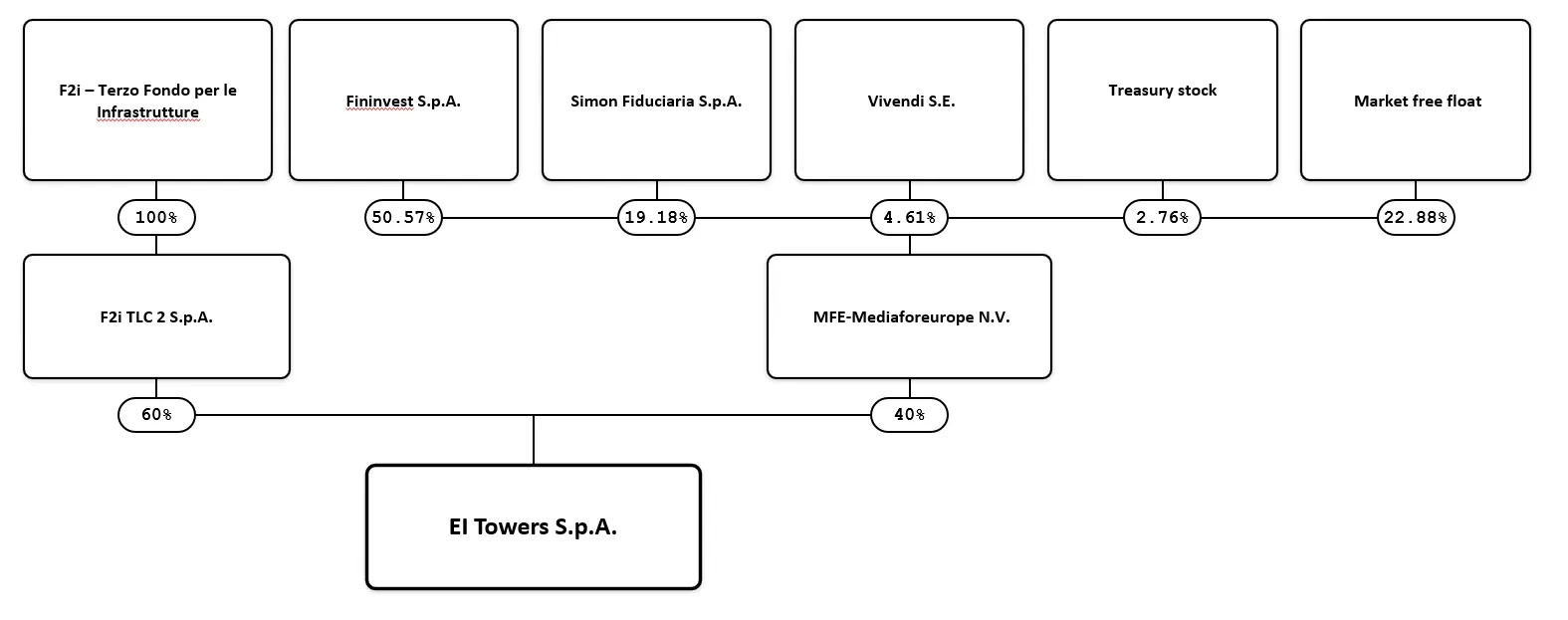
Figure 1 shows EI Towers’ ownership structure: F2i and MFE-MediaForEurope control it jointly through F2i TLC 2, with Fininvest, Vivendi, treasury stock and the market free float sitting above MFE-MediaForEurope itself.
2.5 Rai Way
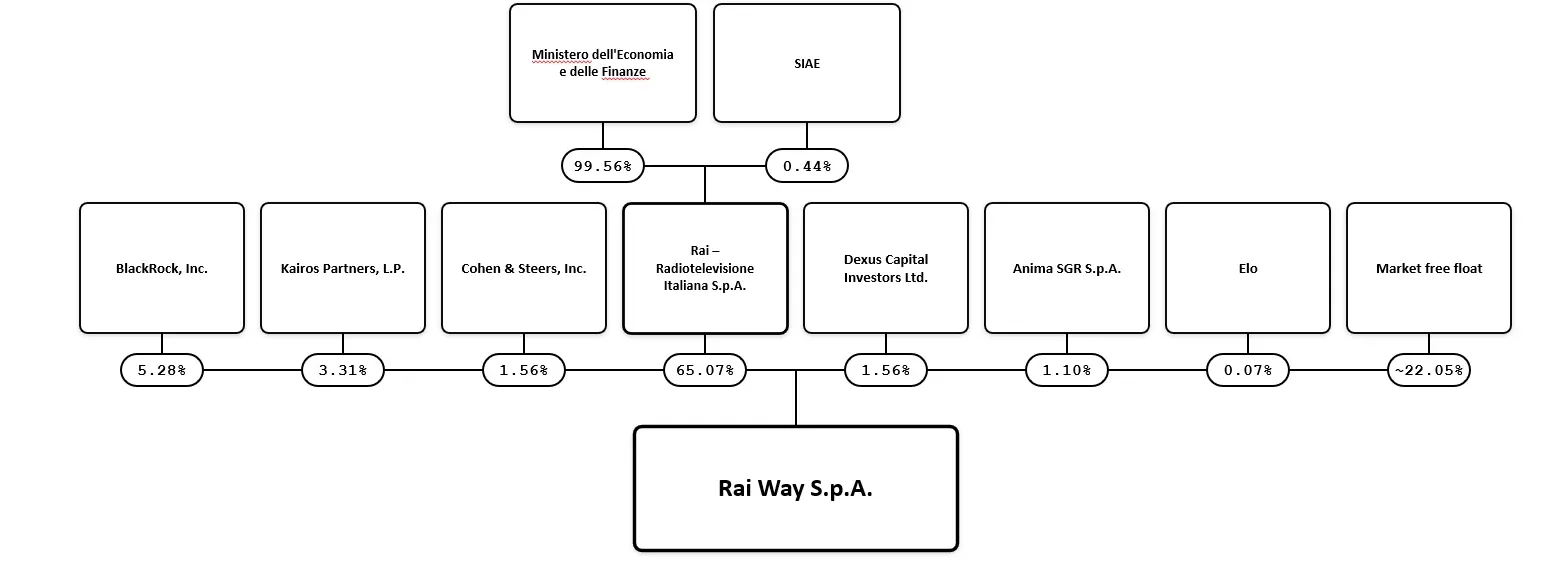
Rai Way S.p.A. is an Italian telecommunications and infrastructure company that owns and operates the network used to transmit television and radio signals across Italy. It is a subsidiary spun off by RAI to handle the physical and technical infrastructure, and it was listed on Borsa Italiana in November 2014. RAI holds 65 per cent of the capital and the remaining 35 per cent is free float, across a total of 272 million shares. The portfolio amounts to roughly 2,400 sites.
The Ministero dell’Economia e delle Finanze (MEF) is the government body that holds ownership and financial control over RAI, and therefore, indirectly, over Rai Way. This indirect chain of control is the single most important structural fact in this entire story, because it means that every commercial negotiation involving Rai Way is also, unavoidably, a political negotiation.
2.6 The MEF
The MEF is headed by a minister, appointed by the President of the Republic on the formal proposal of the President of the Council of Ministers. Silvio Berlusconi had been President of the Council until 2011, leading the country at the head of his centre-right party. In February 2014, Matteo Renzi was appointed President of the Council at the head of the centre-left Partito Democratico.
It falls to the President of the Republic, on the formal proposal of the President of the Council, to appoint the Minister of Economy and Finance. Renzi, of the centre-left PD, proposed Pier Carlo Padoan to President Giorgio Napolitano, himself a former member of the Italian Communist Party. In 2015 we therefore find a MEF that is politically and culturally of the centre-left, the opposite of the position of the Berlusconi family. This would have an important influence on the 2015 offer by EI Towers for Rai Way.
Figure 2 shows Rai Way’s ownership structure: the MEF controls RAI, which in turn holds 65.07 per cent of Rai Way, alongside institutional shareholders and the market free float.
2.7 CONSOB and the AGCM
CONSOB (Commissione Nazionale per le Società e la Borsa) regulates and supervises the Italian financial markets, investment products and listed companies, in order to protect investors and ensure market transparency.
AGCM (Autorità Garante della Concorrenza e del Mercato, also known as the Antitrust Authority) is the national competition and fair trading regulator, responsible for safeguarding market competition, enforcing antitrust rules and combating unfair commercial practices across all economic sectors.
Each authority operates under its own legal framework, and they formalise their cooperation through periodic Memoranda of Understanding to coordinate interventions and share intelligence. In the 2015 offer both were involved, and in sequence: the AGCM decided whether the deal could exist at all, and CONSOB governed the mechanics of the tender offer itself.
3. The 2015 offer
On 24 February 2015, EI Towers launched a voluntary tender and exchange offer for all of Rai Way’s ordinary shares, 272,000,000 in total, at an implied value of 4.50 euros per share, made up of 3.13 euros in cash plus 0.03 newly issued EI Towers shares for each Rai Way share. The total valuation of Rai Way was therefore about 1.225 billion euros, split into roughly 850 million euros in cash and 374 million euros in EI Towers shares. The offer was conditional on EI Towers ending up with at least 66.7 per cent of Rai Way’s capital.
On 23 February 2015 Rai Way shares had been trading at 3.69 euros, so the offer framed a premium of 22% to that price. On the day of the announcement the market welcomed the offer, with the share immediately peaking at 4.37 euros and then closing at 4.05 euros, still below 4.50 and representing a premium of 11.1 per cent on the pre-announcement price. EI Towers shares before the announcement were trading at 45.83 euros, and this was also the price EI Towers used to calculate the share component of the offer. The board approved the offer the following day after market hours, and on 25 February 2015 EI Towers shares peaked at 50.20 euros, a premium of 9.5 per cent on 45.83, before closing back at 48.00 euros, a premium of 4.7 per cent.
On 27 February 2015, the MEF issued a press release stating that it intended to retain a public equity interest of 51 per cent in the share capital of Rai Way. As noted above, the prime minister at the time was Matteo Renzi, leader of the centre-left PD, while EI Towers was controlled by the Berlusconi family, founders of the centre-right party Forza Italia. Renzi moved to block the sale of the majority of Rai Way for two reasons. The first was that he considered television and radio transmission towers a strategic asset of the State, not to be left entirely in private hands. The second was to avoid a situation in which the direct private competitor of State television, the centre-right Mediaset, would have influence over the technological backbone of RAI.
On 11 March 2015, the AGCM launched a formal antitrust inquiry, warning that a merger would restrict competition in digital broadcasting and could unfairly favour Mediaset.
On 31 March 2015, the AGCM formally notified EI Towers that the deal could not be authorised in its current form.
On 10 April 2015, following the regulatory stoppage, EI Towers reduced its minimum acceptance threshold from 66.7 per cent to 40 per cent.
On 15 April 2015, the AGCM investigation produced a preliminary decision stating that the deal would have created a single vertically integrated “operatore unico” controlling 70 to 75 per cent of Italy’s television broadcasting infrastructure, with a dominant position reinforced by Mediaset’s position in TV advertising, producing harmful horizontal and vertical effects. It would also have created or reinforced a dominant position in radio broadcasting infrastructure, though not in mobile telecom infrastructure.
On 20 April 2015, EI Towers confirmed to CONSOB that the conditions for pursuing the tender offer no longer existed. The AGCM closed the case on the same day, with no grounds to rule.
3.1 Market value for the deal
The economics of the 2015 offer, reconstructed from the terms of the announcement, are set out below.
Table 1. Economics of the EI Towers offer for Rai Way, 24 February 2015
| Item | Value | Note |
|---|---|---|
| EI Towers newly issued shares | 8,160,000 | 8 million |
| EI Towers reference share price | 45.83 EUR | close of 23/02/2015 |
| Value of newly issued shares | 373,972,800 EUR | 374 million |
| Exchange ratio | 0.03 | EI Towers shares per Rai Way share |
| Stock value per Rai Way share | 1.3749 EUR | 31% of consideration |
| Cash per Rai Way share | 3.13 EUR | 69% of consideration |
| Offer price per Rai Way share | 4.5049 EUR | headline 4.50 EUR |
| Rai Way shares outstanding | 272,000,000 | 272 million |
| Rai Way implied equity value | 1,225,332,800 EUR | 1,225 million |
| Value of 66.7% minimum acceptance | 816,929,377 EUR | 817 million |
| Value of 40% minimum acceptance | 490,133,120 EUR | 490 million |
| EI Towers shares outstanding | 28,262,377 | 28 million |
| EI Towers equity value pre-deal | 1,295,264,738 EUR | 1,295 million |
| Combined group equity value | 2,520,597,538 EUR | 2,521 million |
The share price behaviour of the two companies over the offer period tells the story of the deal better than the announcement did.
Figure 3 shows Rai Way’s share price trend between the announcement and the closure of the offer.
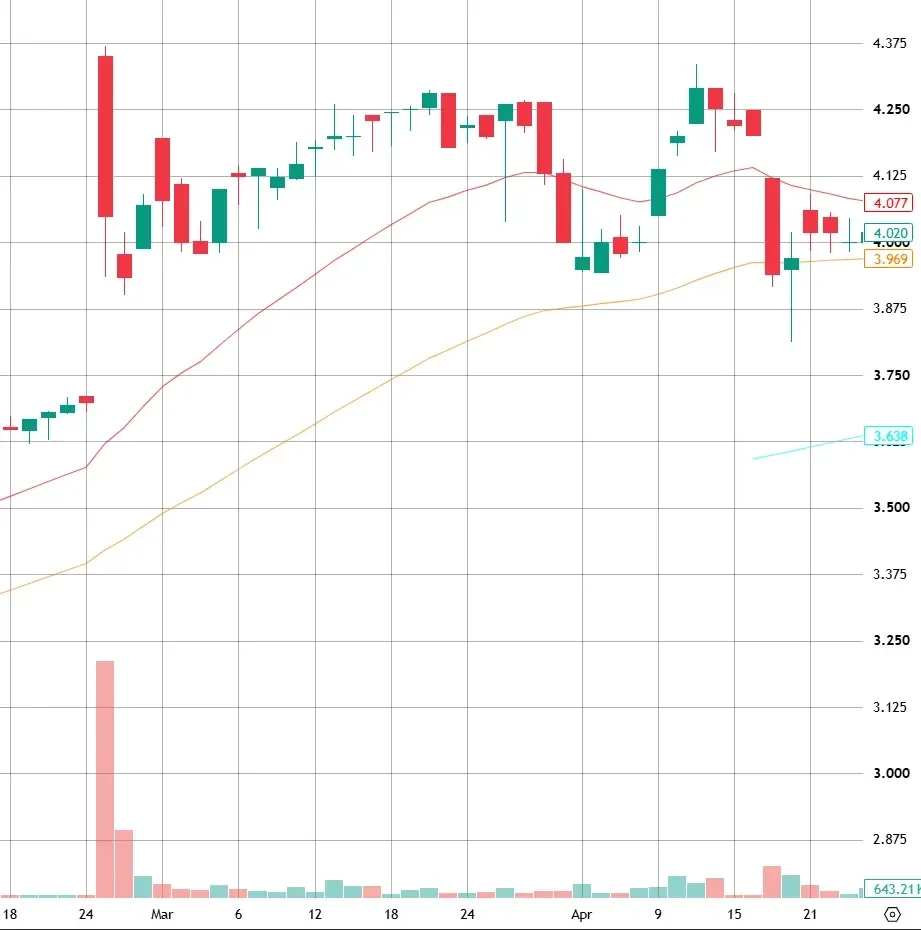
Figure 4 shows EI Towers’ share price trend over the same period.
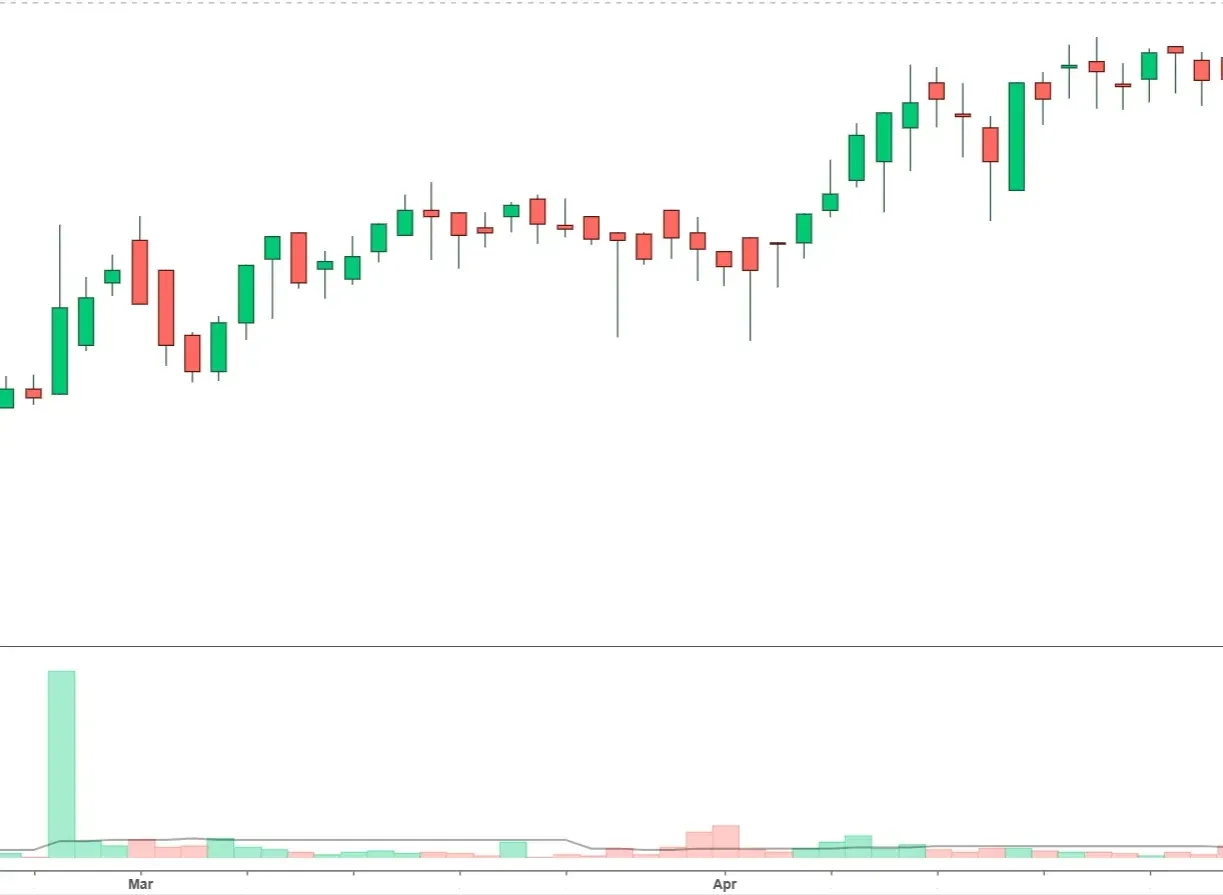
Table 2. Share prices and premiums over the offer period, 23 February to 15 April 2015
| Date | EI Towers | Premium on 45.83 | Rai Way | Residual premium to 4.5049 |
|---|---|---|---|---|
| 23/02/2015 (pre-announcement) | 45.83 | n/a | 3.69 | 22.0% |
| 25/02/2015 (intraday high) | 50.20 | 9.5% | 4.37 | 3.0% |
| 25/02/2015 (close) | 48.00 | 4.7% | 4.05 | 11.1% |
| 11/03/2015 (AGCM opens inquiry) | 49.23 | 7.4% | 4.15 | 8.4% |
| 31/03/2015 (AGCM blocks as structured) | 49.58 | 8.2% | 4.00 | 12.5% |
| 15/04/2015 (AGCM preliminary decision) | 52.55 | 14.7% | 4.22 | 6.6% |
Two things stand out. The first is that Rai Way never traded at the offer price. Even at its peak on the day after the announcement, the stock closed at a discount to 4.5049 euros, and the gap widened as the regulatory news accumulated: the residual premium to the offer was 11.1 per cent on 25 February, 8.4 per cent on 11 March when the AGCM opened its inquiry, and 12.5 per cent on 31 March when the AGCM said the deal could not be authorised as structured. The market, in other words, never believed the offer would complete, and priced the probability of failure from the first day.
The second is that EI Towers shares rose, and kept rising, throughout the period. By 15 April, with the deal effectively dead, EI Towers was trading at 52.55 euros, 14.7 per cent above its pre-announcement price. This is unusual: the acquirer in a large cash-and-share offer normally trades down, because it is issuing paper and taking on leverage. What the market was actually re-rating was the strategic scarcity of Italian broadcast infrastructure, which the offer had just made visible, and the fact that failure spared EI Towers the cost of the acquisition while leaving it with the same asset base.
4. The EI Towers takeover
On 16 July 2018, a vehicle called 2i Towers, owned 40 per cent by Mediaset and 60 per cent by the infrastructure fund F2i through F2i TLC, launched a voluntary tender offer for all of EI Towers’ shares at 57 euros per share, a premium of roughly 15.5 per cent to the prior close of 49.35 euros and about 19 per cent to the six-month average price.
The announcement sent the stock up sharply on the next trading day. On 17 July it closed at 56.80 euros, up 15.1 per cent, as the market re-rated the share towards the offer price. Two brokers covering the stock, Equita SIM and Banca Akros, immediately raised their target prices to 57 euros to match the offer, while keeping neutral ratings, since at that point the price was anchored to the bid rather than to fundamentals. The transaction valued EI Towers at an enterprise value of 1.61 billion euros and was financed with about 480 million euros of credit lines from Intesa Sanpaolo, Mediobanca and UniCredit.
It is worth pausing on the difference between this offer and the one three years earlier. In 2015, a Mediaset-controlled listed company had tried to buy a State-controlled listed company, and the State said no. In 2018, the same industrial logic was applied in the opposite direction and inside the private perimeter: rather than acquiring the public asset, Mediaset sold control of its own asset to a financial investor and stayed on as a minority partner. There was no antitrust obstacle, because no market share changed hands, and no political obstacle, because no public asset was involved. The offer therefore completed in three months, against three months of failure in 2015.
4.1 The delisting
The offer succeeded. By early October 2018, acceptances had reached about 97.45 per cent of the share capital, triggering the mandatory purchase and squeeze-out procedure for the remaining shares under articles 108 and 111 of the Italian consolidated financial act (TUF). The free float fell below the threshold needed to stay in the FTSE indices, and the stock was removed from them on 12 October. EI Towers shares were formally delisted from Borsa Italiana’s STAR segment on 19 October 2018, with F2i emerging as the controlling shareholder and Mediaset retaining its 40 per cent stake as a private, unlisted investment.
That delisting matters for everything that follows. From October 2018 onwards, only one of the two tower companies had a public share price. Any future merger between them would therefore have to establish the value of EI Towers by negotiation rather than by reference to a market quotation, and the party holding the listed asset would be negotiating in full view of its own minority shareholders while the other side negotiated in private. This asymmetry would become one of the reasons the 2024 attempt failed.
5. The new reverse offer
5.1 Why this attempt was different
On 19 December 2024, RAI, F2i and MFE-MediaForEurope signed a non-binding Memorandum of Understanding to initiate, with the participation of Rai Way and EI Towers, preliminary analyses of the industrial aspects of a potential merger between Rai Way and EI Towers. The MoU provided for an exclusivity period running to 30 September 2025.
The structure was the mirror image of 2015, and this is why the operation is best described as a reverse offer. In 2015 the private company was buying the public one. In 2024 the public company would be the acquiring entity: Rai Way would remain listed, EI Towers would be merged into it, and the shareholders of EI Towers would receive newly issued Rai Way shares. Because RAI would retain control rather than lose it, there was no obligation for a mandatory takeover bid.
The political precondition that had killed the 2015 offer had also been removed in advance. The MoU was signed in line with a Prime Ministerial Decree that explicitly opened the possibility for RAI to reduce its stake in Rai Way, though not below 30 per cent, while retaining public control. In other words, the government had decided beforehand that dilution of the State’s holding was acceptable, provided the State stayed in charge. What in 2015 had been an insurmountable political veto had become, in 2024, a written permission.
The industrial case was substantial. The combination would have brought together approximately 4,700 sites and generated more than half a billion euros of revenue, creating the national leader in broadcast infrastructure. Governance was sketched out from the start: RAI would hold 50.1 per cent of the voting rights and the power to appoint the chief executive officer and the chief financial officer. Equita estimated recurring synergies of around 32 million euros a year, coming mainly from cost reductions on outsourced maintenance and from workforce optimisation through incentive plans. Other estimates put the savings above 10 per cent of a combined cost base of roughly 200 million euros, which points to a similar order of magnitude.
The market liked it. On the trading day following the announcement, Rai Way rose 3.48 per cent to 5.35 euros.
5.2 Day by day
What follows is the chronology of the eighteen months between the signature and the collapse.
19 December 2024. RAI, F2i and MFE sign the non-binding Memorandum of Understanding. Exclusivity runs to 30 September 2025. Rai Way and EI Towers are to participate in the preliminary industrial analyses. The signature is aligned with the Prime Ministerial Decree allowing RAI to go down to, but not below, 30 per cent of Rai Way.
20 December 2024. Rai Way closes up 3.48 per cent at 5.35 euros. Analysts frame the two catalysts that will drive the stock for the next eighteen months: the synergies from consolidation, and an extraordinary dividend to be paid to Rai Way shareholders as part of the rebalancing of the transaction. Equita would later put that dividend at approximately 1.3 euros per share, payable to Rai Way shareholders only.
Through 2025. The parties work on the industrial, corporate, financial, regulatory and governance aspects of the transaction. No agreement is reached on the exchange ratio.
26 September 2025. Four days before the exclusivity expires, the MoU is extended for the first time. Reports at the time indicate that RAI needs more time to assess the transaction and that the parties are discussing an extension of between three and six months.
End of March 2026. The MoU is extended for the second time, with a new deadline of 15 June 2026.
7 June 2026. With eight days left, the negotiation enters what the Italian press describes as the final sprint. The outstanding issues are no longer industrial. They are the exchange ratio, the treatment of debt, the duration of the service contracts between the tower company and the broadcasters, governance, lock-up periods and exit conditions.
12 June 2026. RAI wants to close by the following Monday. The parties are still defining contractual aspects, in particular the long-term service agreements, which directly affect the relative values of the two companies: a longer contract with MFE raises the visibility of EI Towers’ revenue and therefore its defensible valuation. Positions are reported as not very close. Neither F2i nor RAI is inclined to walk away.
15 and 16 June 2026. The second deadline passes and the MoU is extended for the third time, by a further fifteen days, to 30 June 2026, to allow the completion of the planned activities and to continue the discussions between the parties. The Italian financial press notes that a further extension beyond this one is excluded.
Final days of June 2026. F2i and MFE put forward a last-minute proposal to prevent the negotiation from breaking down. They accept the extension to 2047 of the service contracts between the tower group and the broadcasters, a twenty-year commitment, and in exchange they ask for an adjustment to the exchange ratio in the form of an extraordinary dividend of around 300 million euros to EI Towers shareholders. Under the proposed structure, RAI would still hold 50.1 per cent of the voting rights while owning 44 per cent of the shares, with F2i holding 20 per cent and MFE 14 per cent. RAI rejects the proposal.
30 June 2026, midnight. The Memorandum of Understanding expires without an agreement.
1 July 2026. RAI issues a press release confirming that the deadline has passed without the parties managing to identify a shared basis for negotiation suitable for allowing the transaction to proceed. During the period in which the memorandum was in force, the statement says, the parties carried out in-depth analysis and discussions on the key industrial, corporate, financial, regulatory and governance aspects of the proposed transaction. RAI reaffirms its commitment to pursuing industrial options characterised by soundness, long-term sustainability and value creation, in accordance with its public service mission and the interests of all shareholders. The RAI board of directors, meeting that day to discuss the autumn programming schedule, is briefed on the outcome.
The wording of the press release deserves attention, because it is unusually final. It does not describe a suspension of talks or a need for further analysis. It says that the parties could not find a shared basis on the main industrial, corporate, financial, regulatory and governance aspects of the transaction. That is a list of every dimension of the deal. What failed was not the timetable. It was the agreement itself.
1 July 2026, market reaction. Rai Way falls 6.6 per cent to 4.725 euros, the lowest level since November 2023. MFE A and MFE B shares also fall. Equita cuts its recommendation from Buy to Hold, observing that the end of the aggregation removes a significant part of the upside in the shares and returns attention to alternative scenarios for the valorisation of RAI’s stake. Intermonte maintains a Buy with a target price of 7.70 euros, and Banca Akros maintains a Buy with a target price of 7.10 euros, both arguing that the collapse was largely priced in.
6. Financial analysis of the 2026 merger
The 2015 offer failed for political and antitrust reasons. The 2024 attempt had both of those problems solved in advance, and still failed. The reason is in the two balance sheets, and it can be stated in a single sentence: the two companies were similar in size and completely different in leverage, and no exchange ratio can make that difference disappear without one side paying for it.
6.1 The two businesses on the eve of the deal
Table 3. Rai Way and EI Towers compared, financial year 2025
| Rai Way | EI Towers | Combined | |
|---|---|---|---|
| Revenue | 282.8 m EUR | 266.9 m EUR | 549.7 m EUR |
| Revenue growth | +2.4% | -3.0% | — |
| Adjusted EBITDA | 191.8 m EUR | 155.9 m EUR | 347.7 m EUR |
| EBITDA margin | 67.8% | 58.4% | 63.3% |
| Net profit | 88.6 m EUR | 17.7 m EUR | — |
| Net financial position | -136.5 m EUR | -618.6 m EUR | -755.1 m EUR |
| Dividend paid | 88.6 m EUR | 30.0 m EUR | — |
| Sites (approx.) | 2,400 | 2,300 | 4,700 |
| Ownership | RAI 65%, float 35% | F2i 60%, MFE 40% | — |
| Listed | Yes (Borsa Italiana) | No (delisted 2018) | — |
The revenue lines are close, within 6 per cent of each other, and the site counts are close as well. Everything below the revenue line diverges.
Rai Way converts 67.8 per cent of its revenue into EBITDA. EI Towers converts 58.4 per cent. That gap of 9.4 percentage points is worth about 25 million euros of EBITDA a year on EI Towers’ revenue base, and it is structural rather than cyclical: Rai Way’s anchor tenant is its own parent, on a long-term contract, over a network built and paid for by the State over decades, whereas EI Towers carries the cost base of a company that was assembled by acquisition and refinanced by a private equity buyer.
The trend is also going in opposite directions. Rai Way grew revenue by 2.4 per cent in 2025 and adjusted EBITDA by 3.3 per cent, which is roughly double the contribution of the inflation indexation clauses in its customer contracts, meaning real growth on top of indexation. EI Towers lost 3 per cent of revenue in the same year, as new contractual rates towards the MFE group reduced its core revenue, and held its margin only through a 2.7 per cent cut in operating costs. One company is growing into its margin. The other is defending it.
6.2 The leverage asymmetry
This is the heart of the matter.
Table 4. Leverage profile at 31 December 2025, and pro forma for the proposed dividend
| Rai Way | EI Towers | Combined | Combined after 300 m dividend | |
|---|---|---|---|---|
| Adjusted EBITDA | 191.8 m | 155.9 m | 347.7 m | 347.7 m |
| Net debt | 136.5 m | 618.6 m | 755.1 m | 1,055.1 m |
| Net debt / EBITDA | 0.71x | 3.97x | 2.17x | 3.03x |
| Share of combined net debt | 18.1% | 81.9% | 100% | — |
| Share of combined EBITDA | 55.2% | 44.8% | 100% | — |
Rai Way carries 0.71 times net debt to EBITDA. EI Towers carries 3.97 times. On a combined basis the new group would have started life at approximately 2.17 times, and if the 300 million euro extraordinary dividend requested by F2i and MFE had been paid, at approximately 3.03 times.
Read that from the perspective of a Rai Way shareholder. You own a share of a business with a 68 per cent EBITDA margin, growing modestly, financed at 0.71 times leverage, paying out essentially all of its net profit as dividends, 88.6 million euros in 2025 on 88.6 million euros of net income. The proposal is that you exchange part of that for a share of a business with a 58 per cent margin, shrinking slightly, financed at 4 times leverage, and that the combined entity should then take on a further 300 million euros of debt to pay a special dividend, most of which goes to the other side.
The synergies, at around 32 million euros a year, are real and material: they are about 9 per cent of the combined EBITDA of 347.7 million euros. But they are not large enough to change the arithmetic of the leverage. If the combined group had capitalised the synergies at the same multiple as the underlying business, they would have been worth roughly 275 million euros of enterprise value, less than the 300 million euro dividend that would have been paid out to acquire them. This is very close to what Intermonte said in plain language on the day the deal collapsed: the transaction would have entailed an increase in debt without tangible financial benefits.
6.3 Reconstructing the exchange ratio
The published terms of the final proposal are enough to reverse engineer the valuation the two sides were arguing about, and this is where the negotiation becomes legible.
Under the last structure discussed, RAI would have held 44 per cent of the shares of the combined entity, F2i 20 per cent and MFE 14 per cent, with the balance of approximately 22 per cent held by Rai Way’s existing free float. Since RAI holds 65 per cent of Rai Way, RAI ending with 44 per cent of the combined company implies that Rai Way as a whole represented 44 divided by 0.65, that is 67.7 per cent of the combined equity, leaving 32.3 per cent for EI Towers. That is consistent with the other two figures: 60 per cent of 32.3 per cent is 19.4 per cent, close to F2i’s 20 per cent, and 40 per cent of 32.3 per cent is 12.9 per cent, close to MFE’s 14 per cent.
So the negotiated split was approximately 68 per cent Rai Way and 32 per cent EI Towers of the equity of the combined group.
Now test that split against the fundamentals. If both companies are valued on the same enterprise value to EBITDA multiple, the split of the equity is determined entirely by the multiple, because the debt is subtracted from each side’s enterprise value to get to its equity value. Solving for the multiple that produces a 67.7 per cent share for Rai Way gives approximately 8.6 times.
Table 5. Reconstructed terms of the final proposal, June 2026
| Item | Value | How it is obtained |
|---|---|---|
| RAI stake in combined entity | 44% of shares | stated in press reports |
| RAI voting rights | 50.1% | stated in press reports |
| F2i stake | 20% | stated in press reports |
| MFE stake | 14% | stated in press reports |
| Rai Way share of combined equity | 67.7% | 44% divided by RAI’s 65% of Rai Way |
| EI Towers share of combined equity | 32.3% | residual |
| Implied EV / EBITDA, both companies | 8.6x | solved from the 67.7 / 32.3 split |
| Rai Way implied equity value | 1,513 m EUR | 191.8 x 8.6 less 136.5 |
| Rai Way implied value per share | 5.56 EUR | 1,513 m divided by 272 m shares |
| EI Towers implied equity value | 722 m EUR | 155.9 x 8.6 less 618.6 |
| Combined equity value | 2,235 m EUR | sum |
| Combined enterprise value | 2,990 m EUR | 347.7 x 8.6 |
At 8.6 times, Rai Way’s equity is worth about 1,513 million euros, or 5.56 euros per share, and EI Towers’ equity about 722 million euros. The implied enterprise value of the combined group is close to 3.0 billion euros. Press reports described the prospective group as worth around 4 billion euros, which corresponds to a multiple of about 11.5 times and is best read as an aspirational figure including full synergy capitalisation rather than as the negotiated basis.
The sensitivity of the split to the multiple is the reason the negotiation was so difficult, and it is worth showing explicitly.
Table 6. Sensitivity of the ownership split to the assumed EV / EBITDA multiple
| EV / EBITDA | Rai Way equity | Per share | EI Towers equity | Rai Way share | RAI share |
|---|---|---|---|---|---|
| 7.0x | 1,206 m | 4.43 EUR | 473 m | 71.8% | 46.7% |
| 8.0x | 1,398 m | 5.14 EUR | 629 m | 69.0% | 44.8% |
| 8.6x (negotiated) | 1,513 m | 5.56 EUR | 722 m | 67.7% | 44.0% |
| 9.0x | 1,590 m | 5.84 EUR | 785 m | 67.0% | 43.5% |
| 10.0x | 1,782 m | 6.55 EUR | 940 m | 65.5% | 42.5% |
| 11.0x | 1,973 m | 7.25 EUR | 1,096 m | 64.3% | 41.8% |
Because EI Towers carries far more debt, its equity value is far more sensitive to the multiple than Rai Way’s. At 7 times, EI Towers’ equity is worth only about 473 million euros and Rai Way’s share of the combined group rises to 71.8 per cent. At 11 times, EI Towers’ equity more than doubles to about 1,096 million euros and Rai Way’s share falls to 64.3 per cent. A movement of four turns in the assumed multiple, which is well within the range of reasonable disagreement for an infrastructure asset, moves 7.5 percentage points of the combined company from one side to the other. On a group with an equity value in the region of 2.2 billion euros, that is roughly 170 million euros of value, and it is decided entirely by an assumption rather than by an observable price.
The asymmetry is worth stating explicitly, because it explains the negotiating dynamic. Every turn of multiple added to the valuation of both companies transfers value from Rai Way’s shareholders to EI Towers’ shareholders. F2i and MFE therefore had a structural interest in arguing for the highest defensible multiple, and RAI had a structural interest in arguing for the lowest. That is true in any merger of unequals, but here the leverage gap magnified it: a single assumption, applied identically and in good faith to both companies, still moved hundreds of millions of euros across the table.
This is why the duration of the service contracts mattered so much, and why the negotiation kept coming back to it in June 2026. Extending the MFE contracts to 2047 was not a side issue. A twenty-year contracted revenue stream is precisely what justifies a higher multiple on EI Towers, and therefore a larger share of the combined company for F2i and MFE. When F2i and MFE offered the 2047 extension and asked for 300 million euros in exchange, they were making that trade explicit: we will give you the visibility, you pay us for the value it creates.
6.4 Why RAI said no
RAI’s refusal is coherent once the numbers are laid out.
First, the leverage. RAI would have taken a business at 0.71 times and left it at 3.03 times after the special dividend. For a company whose ultimate shareholder is the Treasury, and whose stated purpose is a public service mission, quadrupling financial leverage to acquire a lower-margin asset is difficult to defend.
Second, the direction of the cash. The 300 million euro dividend would have been funded with debt carried by the combined entity, in which RAI would hold 44 per cent of the economics, and paid out to shareholders of which RAI was not one. In substance, Rai Way’s balance sheet would have financed 300 million euros of value crystallisation for F2i and MFE.
Third, the asset mix. The merger would have roughly doubled the group’s exposure to digital terrestrial television at the precise moment when that exposure is the strategic question rather than the strategic answer. Rai Way’s own stated growth path runs through diversification: data centres, edge infrastructure, hosting for third parties. Doubling down on DTT towers runs against it.
Fourth, governance. RAI was being offered 50.1 per cent of the votes on 44 per cent of the shares, that is, control without proportional economics. That structure is defensible if the asset being acquired is clearly accretive. It is much harder to defend when the acquired asset is more leveraged and lower margin than the acquirer.
6.5 What the market paid, and what it took back
The clearest verdict on the transaction is the one written in the share price.
Table 7. Rai Way share price through the transaction, December 2024 to July 2026
| Date | Event | Price | Market cap | EV / EBITDA | Change vs pre-MoU |
|---|---|---|---|---|---|
| 18/12/2024 | day before the MoU | 5.17 EUR | 1,406 m | 8.0x | n/a |
| 20/12/2024 | day after the MoU | 5.35 EUR | 1,455 m | 8.3x | +3.5% |
| 30/06/2026 | MoU expiry, last close | 5.059 EUR | 1,376 m | 7.9x | -2.1% |
| 01/07/2026 | termination announced | 4.725 EUR | 1,285 m | 7.4x | -8.6% |
Rai Way traded at approximately 5.17 euros before the memorandum was announced and closed at 5.35 euros the day after. Eighteen months later, on the day the negotiation collapsed, it closed at 4.73 euros, which is 8.6 per cent below where it stood before the deal was ever announced and 11.7 per cent below the post-announcement level.
The deal premium did not merely evaporate. It went negative. Over eighteen months of exclusivity, three extensions and the full attention of the management of both companies, Rai Way shareholders ended up worse off than if the memorandum had never been signed. Part of that is the market marking down the standalone business as the DTT question became more pressing. Part of it is the opportunity cost of eighteen months during which the standalone diversification plan was, necessarily, a secondary priority.
It is also worth noting what the share price says about market efficiency here. Equita and Intermonte both observed that the collapse was largely priced in, and the evidence supports them: a 6.6 per cent fall on the day of a definitive termination is a modest reaction, which means the market had already assigned a low probability to completion well before 30 June. The repeated extensions, each one shorter than the last, from nine months to six months to fifteen days, were themselves the signal. In extraordinary transactions, extensions are normal when they are used to complete technical verification. They mean something different when they repeat without resolving the essential terms.
6.6 The valuation gap that never closed
Standing back, the eleven-year sequence has a consistent shape.
In 2015, EI Towers valued Rai Way at 1,225 million euros of equity, or 4.5 euros per share, and the State refused to sell at any price. In 2018, F2i and Mediaset valued EI Towers at an enterprise value of 1.61 billion euros, and that transaction completed in three months because both sides were private and the price was in cash. In 2026, the two sides could not agree on a relative valuation at all, because the currency was equity in a combined entity rather than cash, and because the debt sitting on one side of the transaction made the relative valuation extraordinarily sensitive to assumptions that neither side could impose on the other.
The pattern is that this deal completes when someone pays cash and fails when someone offers paper. Cash settles a valuation dispute. Paper requires the two sides to agree on a shared view of the future, and on the future of digital terrestrial television in Italy, they plainly did not.
7. What happens now
For RAI, the alternative that has been discussed within the company for years now returns to the table: selling the portion of its Rai Way stake above 50.1 per cent, roughly 15 per cent of the capital, in order to finance its business plan while retaining control. At the 1 July closing price, 15 per cent of Rai Way is worth approximately 193 million euros. Whether that route is actually taken remains to be seen, and it has been considered and set aside before.
For Rai Way as a listed company, the collapse reopens the independent scenario, with increased investment in diversification to serve both RAI and other potential clients. Analysts who maintained their Buy recommendations did so on precisely this basis, arguing that the standalone company, unlevered and cash generative, is worth more than the market was assigning to it once the deal noise was removed.
For F2i, the outcome is the most damaging. The fund has held the asset since 2018 and has long been aiming to maximise its return and exit the investment. The merger was the exit. Without it, F2i owns 60 per cent of an unlisted, highly leveraged infrastructure company in a market with no obvious alternative buyer, at a point in the fund’s life when the pressure to realise value increases rather than decreases.
For MFE, EI Towers is left in limbo. It remains an important asset, but it has not been central for years to the Europe-wide industrial development strategy pursued by the group led by Pier Silvio Berlusconi. A 40 per cent stake in a domestic tower company is not the currency MFE needs for the consolidation of European commercial television.
8. Conclusion
There is one further question that sits underneath all of the negotiating detail, and it may turn out to be the most important one. A merger between two operators in an expanding market follows very different logic from a combination that happens when a market is showing signs of post-maturity. In the second case the argument is not only about the price of the assets or the distribution of power, but about how much confidence the shareholders have that the sector will keep creating value over the medium and long term.
Broadcast towers will remain essential infrastructure for years, and nobody is forecasting their rapid obsolescence. But terrestrial broadcasting in Italy has no particular evolution scheduled, to the point that even DVB-T2 has never really taken off, while the communications ecosystem around it moves towards converged networks, cloud, content delivery networks, edge computing, satellite and terrestrial integration, direct-to-device connectivity and, in the next decade, the architectures enabled by 6G. In that scenario the competitive advantage may gradually shift away from owning high towers and high power sites, and towards the ability to integrate heterogeneous platforms and networks.
That may be the question that quietly accompanied the entire negotiation. Not whether the merger was industrially rational, which it probably was, but whether being industrially rational was enough for the market that is now taking shape. If value really does migrate from the towers to the platforms, the real risk is not having walked away from a merger. It is discovering that, in the meantime, the world in which that merger was supposed to live has changed.