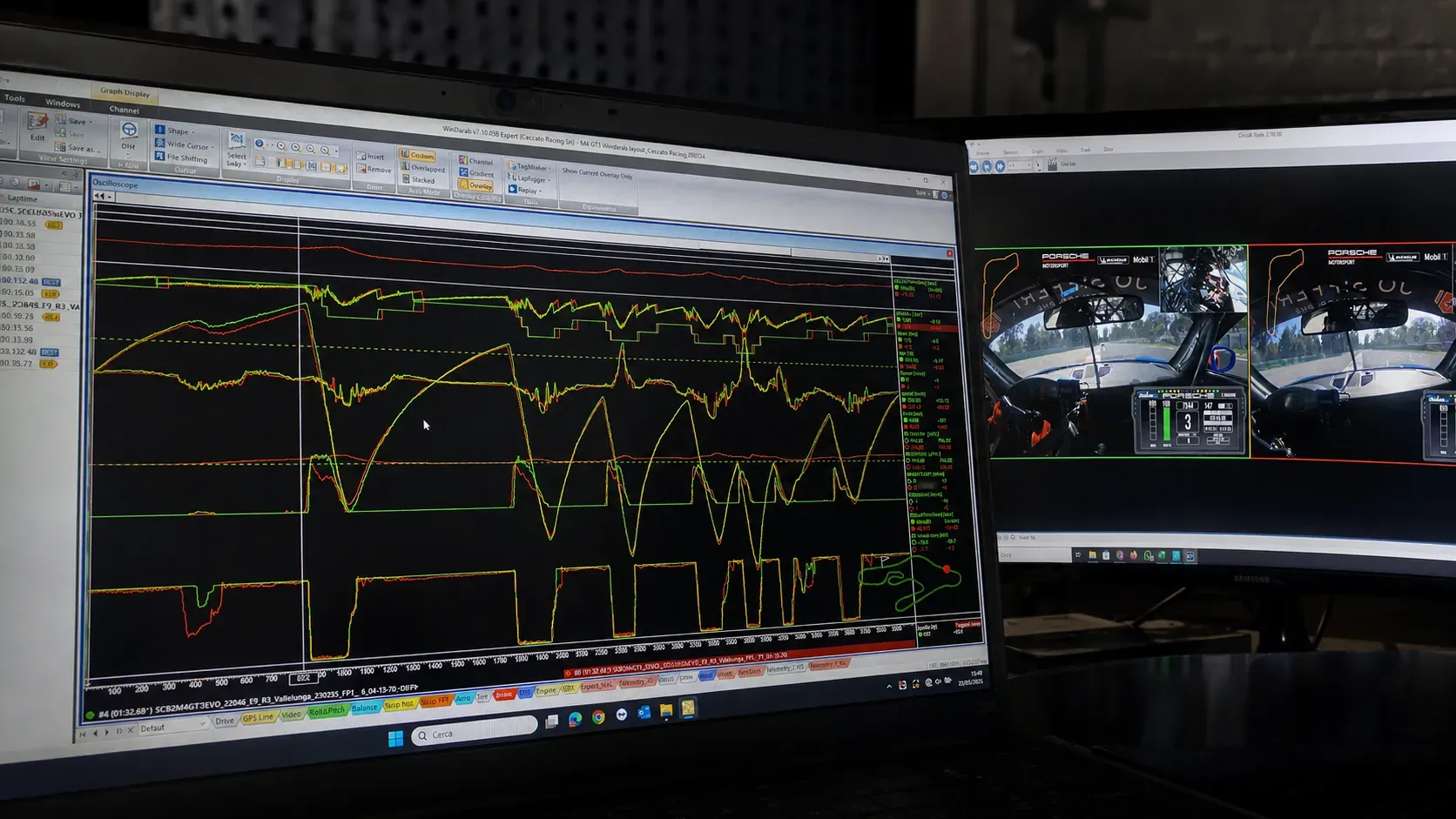
How to Conduct a Driver Performance Analysis
A step-by-step method for comparing onboard footage and telemetry data, from choosing the right benchmark lap to correcting corner-specific mistakes
1. Introduction
I have never been one of those talented drivers who jump into a car, impress everyone after a handful of laps, and could not tell you why or how I did it. I had to learn every single aspect of technical driving style, one piece at a time. It was only by understanding all of the technicalities that I was able to reach a high level of competition.
Over the course of my racing experience, that necessity turned into a method: I built a fixed, repeatable way of analysing telemetry and improving my driving on track. It is a process that works well for me. There may well be better ways to analyse a driver’s performance, but from my perspective this is one of the most effective ways to fully understand and interpret telemetry data and to turn it into real improvement behind the wheel.
What follows is that process.
2. Situational evaluation
Before anything else, you need a clear overview of what you are actually going to analyse. Above all, you need to understand which benchmark you are looking at, because everything that follows (every line, every trace, every delta) will be measured against it. If the benchmark is the wrong one, the rest of the analysis, however rigorous, will simply point you in the wrong direction.
2.1 Evaluation of the reference lap
The first thing to establish is who the driver you are going to use as a benchmark actually is, and whose performance you are going to take as the reference for improving your own. There are three questions you should ask yourself, and they should be asked in this order:
- Is he genuinely fast in this car, and does he consistently stay in the top positions?
- Is he driving in this particular lap (the benchmark) as fast as he is known to be?
- Is he driving well? Is his driving style something I can realistically try to imitate, or is it something extremely difficult to reproduce?
The first two questions are about the driver and about the lap itself. The third is about what you see on the video. Once you have answered the first two, watch his onboard lap straight through, without stopping it: at this stage it should be nothing more than a quick, continuous viewing, because you are not analysing yet, you are forming an impression. Then ask yourself the third question.
The first question: is he a valid reference at all? This question matters more than it appears to, and it matters most at the very beginning of a career and for a gentleman/bronze driver. In those situations there are many other drivers who are faster, and it is easy to end up benchmarking yourself against someone who simply is not a good reference. Before you invest hours of analysis into someone’s lap, make sure that driver is genuinely fast in that car and consistently among the top positions.
The second question: was this particular lap a good one? Unfortunately this question is not an easy one to answer. As a general rule it is always better to work from documented laps: laps set in official sessions, where the driver’s lap time is officially recorded on paper: a qualifying lap, an official practice lap, a race lap. A documented lap gives you a guarantee that what you are looking at is a real performance and not simply a fast-looking lap.
The third question: can you actually imitate that style? I believe this third question is the most important, especially for a driver who is starting his racing career and for a gentleman/bronze driver. It is counterproductive to try to match the driving style of a fast driver whose style is difficult to imitate. Concretely, it is counterproductive to copy the style of a driver who drives aggressively, moves the steering wheel constantly, and whose car never stops moving and is never balanced. Sometimes it is better to take a slower reference lap, one where everything is done well but the car is not being pushed to the absolute limit, where it does not move around too much and where there is no evident oversteer, no sense that the car is right on the edge. That kind of lap is a target you can realistically reach. Be careful, because there are fast drivers whose onboard looks extremely slow and undramatic, and who nevertheless end up among the fastest. Those are your perfect benchmark, not the drivers whose onboard makes your heart leap into your throat as you watch them wrestle the car and catch oversteer.
Because I had to learn how to perform at a high level through repetition and practice, I ended up driving fast with a clean driving style, exactly the kind of style that can be used as a reference and taken apart in analysis. Instinctive, naturally talented drivers often cannot serve as a reference point, because they do not know what they are doing. Or rather: they do know, but they know it with enormous naturalness and very little conscious awareness, because they do things by instinct. Those are the drivers everyone calls prodigies, and a prodigy is a wonderful thing to watch, but a very difficult thing to learn from.
These three questions, then, are the starting point for evaluating the reference lap you are going to benchmark yourself against for the whole analysis.
2.2 Evaluation of the overall conditions
Once you have understood who the driver is and what his driving style is like, you have to understand the conditions in which he set that lap.
One caveat first. If you only want to compare your onboard with his, without looking at lap time and speed, purely comparing racing lines, on the assumption that his lap is a good one, you can skip this step. But if you also want to compare telemetry data, you have to take it into account.
What matters is assessing the conditions of the benchmark against your own. The variables are many:
- Track temperature, humidity and season
- Condition of the tyres
- Fuel quantity and car weight
- Track usage
- Set-up and Balance of Performance (BOP)
This is why the best and most effective way to benchmark yourself is to have the benchmark inside your own team, or to have a coach who drives the car immediately before you, so that the conditions are the same ones you are about to drive in. That is the most efficient way to work and to understand immediately what needs improving.
Track and car conditions vary enormously from one day to another, and this makes it extremely difficult to compare your performance precisely with another driver’s performance set on a different day. The most effective comparison is with a driver in the same car or in the same team on the same day. There is no better way to compare yourself with another driver and improve your performance efficiently.
3. Line & eye positioning
3.1 Line positioning
Before diving into telemetry analysis, I believe it is better to look at line positioning, using the onboard footage.
Why look at line positioning first? Because from my point of view it is the very foundation of a performance analysis. If two drivers are running different trajectories on track, it is not possible to compare their driving techniques: they are in two different positions on the circuit, effectively doing two different things. Any telemetry comparison built on top of that is comparing things that are not comparable.
And line positioning is not merely a preliminary step, it is already a performance analysis in its own right, because you are evaluating whether you are in the correct position on track relative to the benchmark, or in the wrong one, and therefore driving a different track altogether.
This is also why, if you find big differences at this stage, you should stop. Do not move on to analysing telemetry. You are not a stupid guy if you do not analyse telemetry; it simply means you are not ready yet. Trust the process, and do not try to do more than you can do right now. Changing your line in three corners is already a big change, because it means you are going to approach and see those corners in a completely different way.
The tools: to do a proper line positioning analysis you need software that lets you place your video next to your benchmark’s video, so that you can analyse the two side by side. The best tools automatically re-synchronise the two laps, so that both cars are always at the same point on track even when one lap is faster than the other (for example, CircuitTools). Alternatively, you can use a generic side-by-side video analysis tool and re-align the two videos manually at every corner, just before the braking point (for example, Kinovea on Windows or OnForm on iOS).
One note on an alternative many people suggest: several engineers have told me to look at the GPS trajectory in the telemetry software instead. I have always found that imprecise and misleading.
Quick tip: when evaluating car positioning on track, it’s sometimes hard to tell if your GT car is in the exact same position as your benchmark. A difference of just 1 or 2 metres is huge, but it’s not always easy to spot on onboard footage. To fix this, use the windshield wiper as a visual reference point. This will make it much easier for you to gauge your relative position on the track and see if the car is placed properly.
Figure 1 shows two onboard laps around the same corner, synchronised side by side, with the windshield wiper used as a visual reference point.
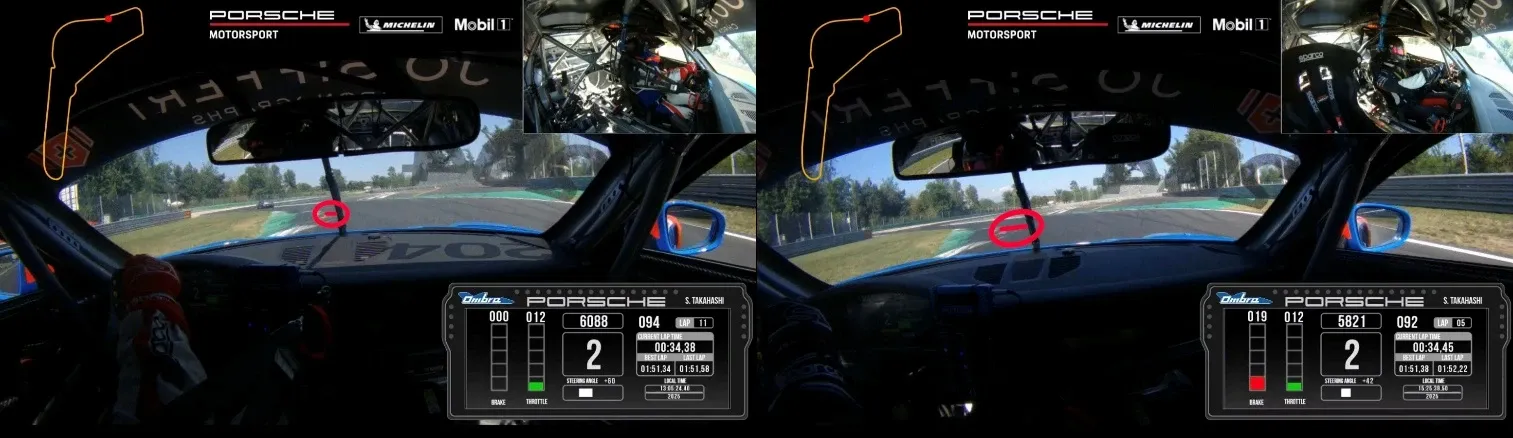
The driver on the left isn’t holding the brakes long enough. He’s entering the corner too fast and turning in too early. He makes up time on the entry, but his exit is going to be a mess.
3.2 Eye positioning
In the corners where you make line mistakes, ask yourself the obvious follow-up question: are you looking at the right point on track?
If you are preparing for a professional race, this is a subject you should address before you get to the track, in the simulator, weeks before the event. It is the most important thing in racing, as it is in many other sports, and it is dense enough that I may dedicate a future article to it.
In any case, the best way to work on it is to have a coach who helps you understand where you are actually looking while driving, and what the best way to approach a corner with your eyes is. In many cases I have found that wrong line positioning is simply the effect of wrong eye positioning.
To be honest, I have been driving since I was six and nobody ever really taught me this. When you are young, some things come naturally, and when I moved to car racing at the age of sixteen it also came fairly naturally, because I was used to karting. For newcomers to car racing and for gentleman drivers this is not natural at all, you have to learn how to approach a corner with your eyes.
4. Telemetry & onboard analysis
Welcome to the hot topic: telemetry analysis.
Now that you have identified the corners where you are running the same line as your benchmark driver, you can analyse those corners through telemetry to see and understand what to improve in your technical driving.
The distinction to keep in mind throughout this chapter is between specific issues and general issues:
- Specific issues are tied to a specific corner on a specific track. Correcting them makes you faster in the short term.
- General issues are driving technique issues that repeat several times within a lap and across different tracks. Correcting them makes you faster in the long term.
4.1 Common patterns and general issues in the telemetry
Before focusing on specific issues, try to understand what the general issues are, the common patterns you can see in the telemetry against your benchmark, repeating several times in a lap and across different tracks. I will not explain each of them here; for now I will simply list them.
Remember that these are the issues that give you the best long-term advantage. They are the skills that will make you a faster driver in the future. The specific issues will not guarantee you anything at another track.
I have chosen to split them into different areas, which are also the areas you can analyse in the telemetry.
Speed:
- Entry speed too fast (a beginner’s mistake)
- Entry speed too slow
Braking:
- Missing initial brake pressure
- Trailing off the brake too quickly
- Not trailing at all
- Not holding brake pressure until the apex
Throttle:
- Late on the throttle (often the consequence of too much entry speed)
- Too early on the throttle (often the consequence of too little entry speed)
- Harsh throttle application
- Over-gentle throttle application (lack of confidence)
Steering wheel:
- Not braking in a straight line
- Too gentle with the initial steering input (and then slow to unwind the steering wheel)
- Not using all of the available steering angle
A warning: tell the cause apart from the consequence. Be careful when analysing common issues or patterns, because you have to distinguish which one is the real problem. The common issue is usually not created at the exit of the corner; it is created at the entry.
Take an example. You spot a common pattern: you are always late on the throttle. So the next time you go on track you try to get on the throttle earlier, and you crash. What you found was real, but it was a consequential pattern: the place where you lose the time, not the pattern that causes you to lose it, and which then generates the late throttle application in the first place.
Quite often, the pattern that makes you lose time in a lap is the one that does not make you lose anything at the moment you do it, you may even gain time there, and only makes you lose time in the second part of the corner.
Take the same example again, but analyse it properly. You spot the same pattern: you are late on the throttle. This time you do not stop there. You carry on analysing the whole corner, and you see that in the late braking phase you release about 10% more brake pressure than your benchmark. That makes you enter the corner 3 km/h faster, which in turn forces you to apply the throttle 30 metres later, which costs you 10 km/h on the exit. In this example the problem is not on corner exit, where you lose the time; it is on corner entry, where you gain it by releasing 10% of brake pressure.
4.2 Corner-by-corner gap
Before addressing specific driving issues, you have to understand in which corners you are actually losing most of your time. So what is the best way to work out how much you are losing in a given corner?
You cannot evaluate the corner in isolation. You also have to evaluate its exit, all the way to the braking point of the next corner, because the way a corner is approached often changes depending on how long the straight after it is.
The correct way to evaluate the time gained or lost in a corner is therefore to measure the delta time from the start of braking for that specific corner to the start of braking for the next corner. You have to start at the braking point of the corner itself because you do not want your evaluation to be influenced by the preceding straight, which is a consequence of the preceding corner.
I have seen several engineers make the mistake of considering only the corner itself when showing the delta gained or lost, and in doing so losing the entire straight that follows it, a straight that is a direct consequence of that corner.
Figure 2 shows the speed, throttle and brake traces for the same corner, compared between two laps.
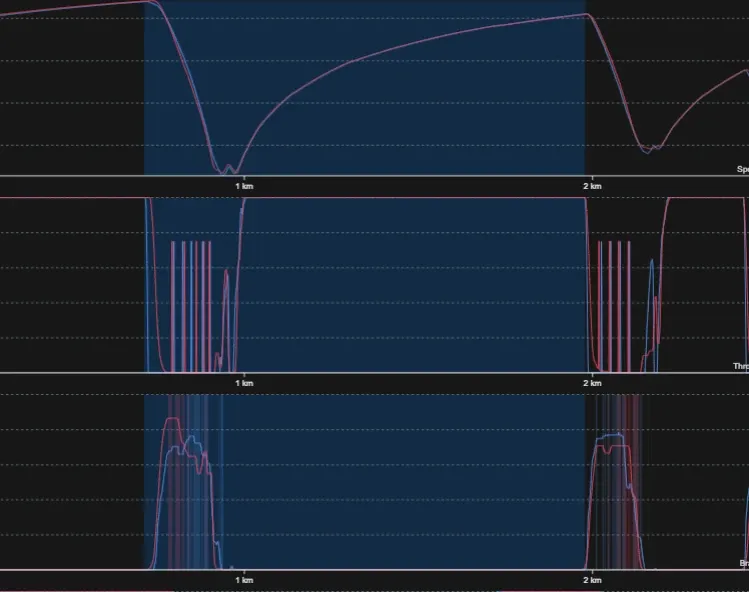
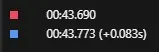
Figure 3 shows the resulting delta time between the two laps at that point on track.
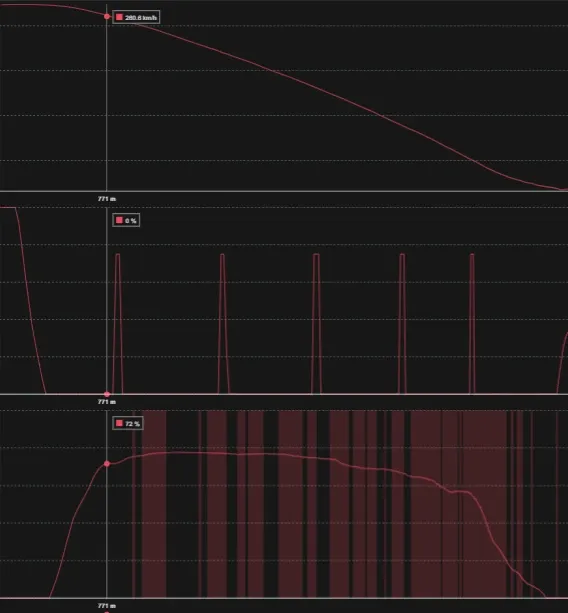
Another useful technical point on the same subject. When you look at where we brake, in order to compare your braking point with another driver’s, you have to consider the point where the first pressure peak occurs, not the moment at which you start touching the brake. Most racing drivers brake with two feet, and there is always some overlap between throttle and brake. Our brain recognises the braking point as the point of the first braking peak, not the moment the pedal is first touched. This is another common mistake I have repeatedly seen among engineers who have never raced a car themselves. (I love and highly respect engineers — I only want to share my experience.)
Figure 4 shows the moment the brake pedal is first touched. This is not the braking point.
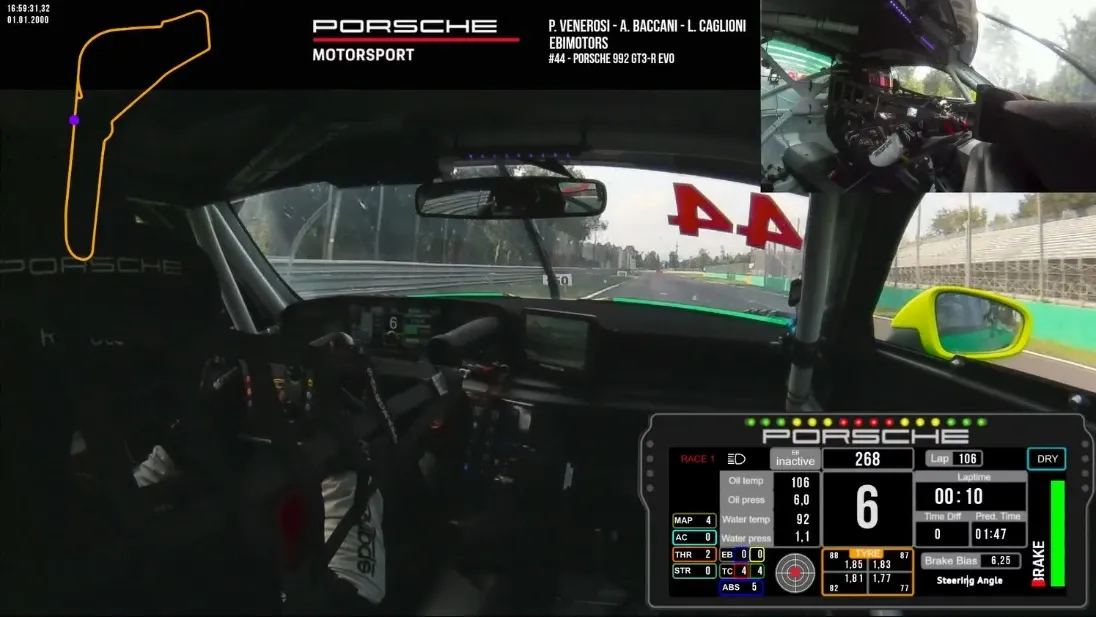
Figure 5 shows the same corner a fraction of a second later, at the first pressure peak. This is the braking point.
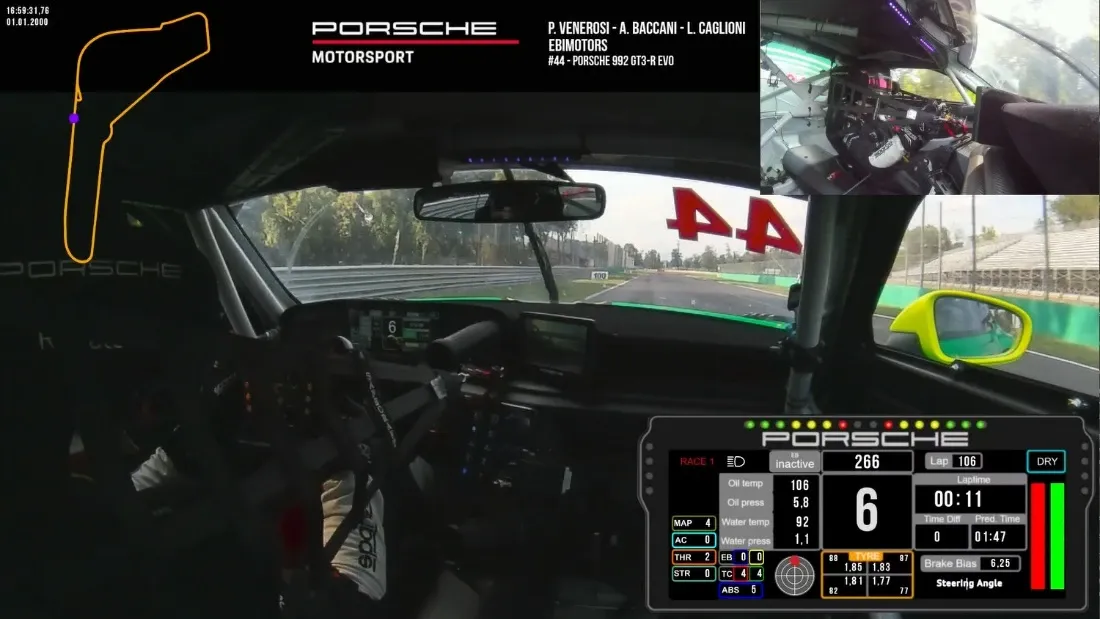
Figure 6 shows how the braking point appears in telemetry: the first peak pressure (white vertical line), not the moment you start touching the brake.
4.3 Corner-specific issues
Once you have defined the corners where you lose most of your time, you can analyse those corners using both the telemetry data and the video, in order to understand what you can improve.
Sometimes you lose time without immediately understanding the reason, and it is only after a deep analysis (telemetry software and video together) that you spot the difference which causes the loss of time or produces a specific consequence.
As I already mentioned in section 3.1, it is important to analyse the telemetry carefully and to work with an engineer, and better still with an experienced driver or coach who can help you understand what the real issue in the corner is. Once again: often the issue is not where you lose time in the corner, but where you gain it. Thorough and experienced analysis is the basis of any improvement in performance.
It is also important to understand whether the mistake is generated by a technical error or by a lack of confidence. Everything depends on how you feel in the car:
- Do you feel 100% comfortable? Can you run ten laps within a five-tenths window?
5. Final evaluations
5.1 Balancing general adjustments and specific adjustments
As I have repeated continuously up to this point:
- Addressing specific issues — faster in the short term, less productive in the long term, and they hardly ever make you an overall faster driver.
- Addressing general issues — faster in the long term, and they do make you an overall faster driver.
How you balance the two depends entirely on the kind of track time you have in front of you.
During a race weekend it is nearly impossible to address general issues, and it is better to focus on specific ones, so that you are as fast as possible in the shortest time possible. Concentrate on the corners where you lose the most time compared with your benchmark.
During a test before a race weekend it depends on how many hours of driving you have available, but it is important to work on both specific and general issues. If you have two test days, it is better to focus on general issues on the first day and on specific issues on the second.
During an off-season test it is definitely better to focus on general issues, because those are the issues that, once addressed, you can then apply to every circuit and be faster everywhere.
5.2 The “one general adjustment or three specific adjustments” rule
How many adjustments or issues should you correct per session?
My suggestion, from my own experience, is this. If you have identified a general issue or pattern, focus on that one alone. Work out carefully in which corners you make that same mistake, and work on improving it there. At the beginning, try to exaggerate the correction in order to address the issue, and keep your focus on that single thing.
When it comes to specific adjustments in different corners, since they will be different in each of the three corners, it is better to limit yourself to three specific adjustments in three specific corners.
If you have the possibility of choosing which corners, pick corners that follow a long straight, so that you have time to think about what you want to do before approaching the corner. Alternatively, choose three corners that are not consecutive.
6. Conclusion
Practice and repetition are the foundation of this sport. Spending ten hours in front of the telemetry and then driving only ten laps does not make you a better driver. The opposite leads nowhere either: you will simply have spent a lot of money without any significant improvement.
You have to understand your mistakes in order to be able to apply the corrections. You will not correct them immediately, the most important thing is to always believe you can improve, and to believe in what more experienced drivers and engineers tell you to do.
I am convinced that if this method enabled me to become a fast driver and compete at high levels of motorsport with good results, it can help anyone achieve comparable success.
All of these considerations are personal considerations, and they should not be taken as a rule of fact.